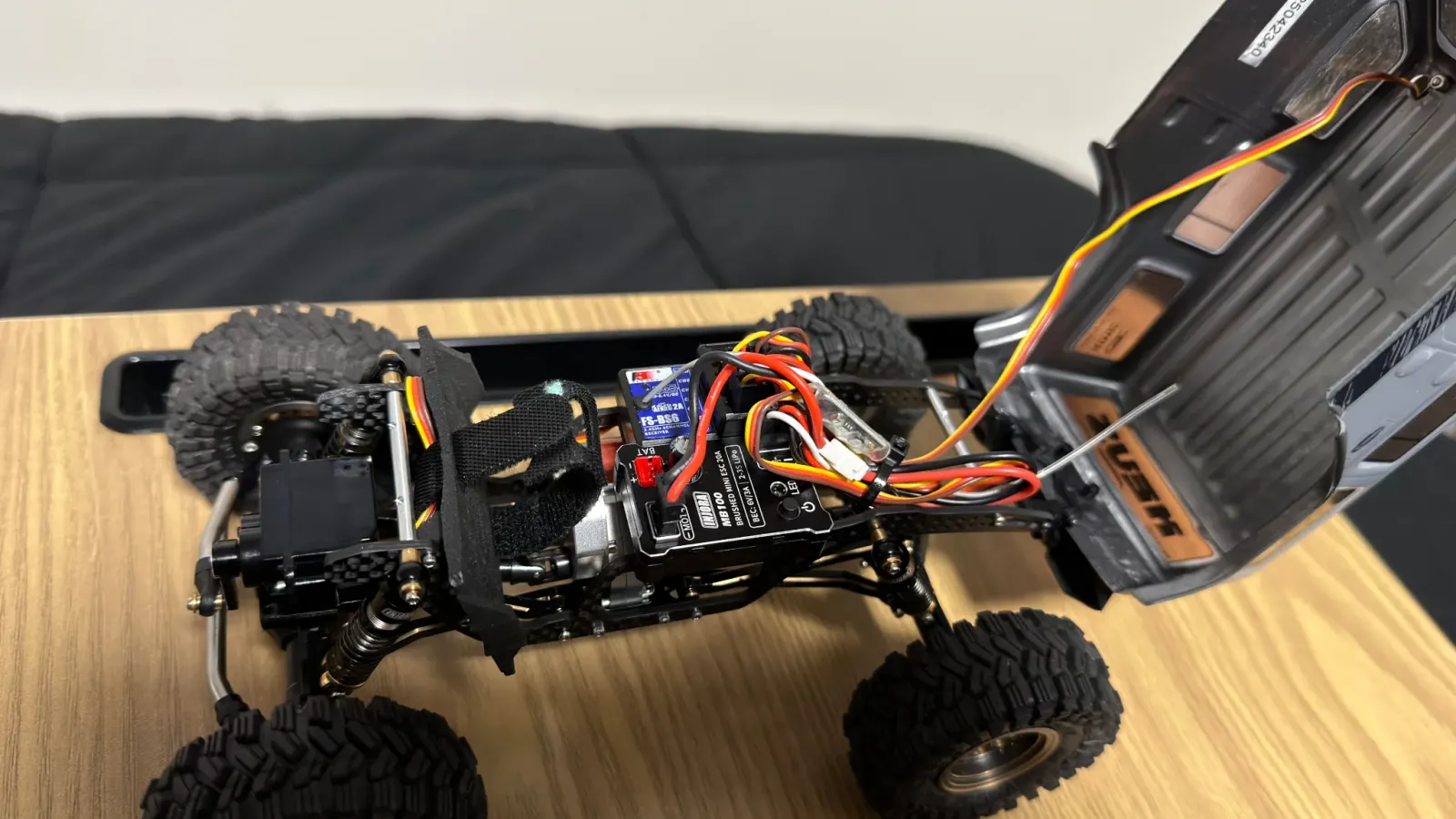
The stock SCX24 has a single tiny board that combines the ESC and the radio receiver in one unit. Axial calls it the “2-in-1.” A BEC (the small voltage regulator that powers the receiver and servo) lives on the same board as part of the ESC stage. Once you understand what the 2-in-1 actually does, you understand why so many SCX24 upgrades require swapping the whole board instead of changing individual parts.
What the 2-in-1 actually is
The board does two main jobs and includes one supporting circuit:
- ESC. Drives the brushed motor forward, brake, and reverse. Rated 10A continuous.
- Receiver. Listens to the transmitter on 2.4 GHz and decodes throttle and steering. Three channels on the older board, four on the newer one.
- BEC. A small voltage regulator integrated into the ESC stage that steps the battery voltage down to a clean 5V for the receiver and the stock servo. 1A continuous.
The board lives in the front hood tray of the chassis, held down by two screws. Cables come off it for battery in, motor out, servo out, and optionally light outputs. A small bind button sits on top.
Which one you have
Two generations exist on production trucks:
- SPMXSE2425RX on most SCX24s released between 2020 and early 2024 (original Jeep, C10, Deadbolt, original Bronco). Runs the SLT2 protocol.
- HRZ00015 on the SCX24 V2 trucks from 2024 onward (Bronco V2, Gladiator, late JLU). Runs the newer 4-channel SLT3 protocol. Smoother low-end throttle, stronger drag brake.
Both are brushed-only. Both ship bound to the radio that came in the kit. Both bind the same way: hold the bind button while powering the truck on, then bind the transmitter.
Why this is the bottleneck on every upgrade
The 2-in-1 is a sealed unit, which means three things you can't change:
- You can't go brushless without replacing the whole board. The ESC stage is brushed-only. There's no “swap to brushless” option that keeps the stock receiver.
- You can't put a 3S pack on it. 1S to 2S only. Higher voltage cooks the regulator.
- You can't feed an HV servo at 7.4V. The BEC is fixed at 5V. HV servos run at reduced spec until you replace the board with one that has a voltage switch (Furitek Lizard, INJORA MBL32, etc.).
Even staying brushed and 2S, the 10A continuous rating and 1A BEC are tight margins once you've upgraded the servo and added a heavier motor. Big servos can pull 2 to 3A under load; the 1A BEC can brown out the receiver mid-input.
The post-2021 receiver issue
Here's the part that catches builders by surprise. On post-2021 trucks (Bronco V2, Gladiator, late JLU) the HRZ00015 board has no usable channel-2 bypass. You can't piggyback a standalone aftermarket ESC onto its receiver. To upgrade the ESC, you have to replace the receiver too.
Earlier production (Deadbolt, original C10, original JLU) used the SPMXSE2425RX which has channel 2 broken out, so a standalone ESC could share the stock receiver. Easier to retrofit.
Practical rule: budget for both the ESC and a receiver when planning any brushless upgrade.
Upgrade path
When you're ready to move past the 2-in-1, my recommendation is to get a standalone ESC and then a separate receiver/transmitter.
Transmitter and receiver picks
If you're going the standalone-receiver path, I personally recommend the Flysky GT5 as a great entry-level transmitter. It pairs with the FS-BS6 (6-channel) or the FS2A (4-channel micro) receiver depending on how many channels your build actually needs. The killer feature is model memory: a single GT5 can hold bindings for up to 20 cars. If you run multiple builds (or your kid runs one too), that's genuinely useful.
The FS2A micro receiver is small enough to live in tight SCX24 chassis. The FS-BS6 is the right pick if you want extra channels for lights, 4-wheel steer, or a 2-speed transmission.
ESC picks
By path:
- Brushed (cheap, reliable, plenty for trail). The INJORA MB100 G2 (around $25) is my pick. MEUS Racing sells standalone brushed ESCs in the same range. Brushed is the right path for most builders staying in trail-class power.
- Brushless. Furitek or Hobbywing. Furitek is my pick because many of their ESCs program over Bluetooth from a phone app, which makes endpoint and drag-brake tuning trivial. Hobbywing combos are also solid and slightly cheaper. Full picks in the best motors and ESC combos buying guide.
What about the original Tactic AE-6
First-generation SCX24s shipped with the Tactic-branded AE-6 2-in-1. Electrically similar to the SPMXSE2425RX. You won't find it on any RTR truck you buy today, but if you pick up a used early SCX24 the AE-6 might be in there. It works fine, but the SLT2 boards talk to it natively so a transmitter upgrade is straightforward.
Bottom line
The 2-in-1 is the first ceiling on every SCX24 upgrade. Until you swap it, you're stuck on brushed, 2S, 5V BEC, and whatever low-current limits the stock board enforces. Once you swap it, the rest of the upgrade paths open up: brushless and HV servos. Pair it with a transmitter that gives you room to grow (the Flysky GT5 holds 20 model slots, which is more than enough for most builders), and you're set up for whatever you want to build next.
Step-by-step ESC and motor swap in the brushless install guide. Where the ESC/RX upgrade sits in the overall plan is covered in the staged upgrade path.