
Every SCX24 owner eventually asks the same question: should I go brushless? The short answer is yes if you crawl a lot, no if you don't. The longer answer is that the choice depends on how the motor talks to the ESC, what the KV number actually means, and what your stock electronics can and can't support. This article unpacks all of that without the engineering-school detour.
How brushed motors work
A brushed motor uses physical contact. Carbon brushes ride against a copper commutator and feed current to spinning windings. The commutator flips the current direction mechanically as the rotor turns. Cheap to make, simple to drive, but the brushes wear and the commutator pits. A stock SCX24 motor is good for around 50 to 150 hours of heavy crawling before it starts feeling tired.
How brushless motors work
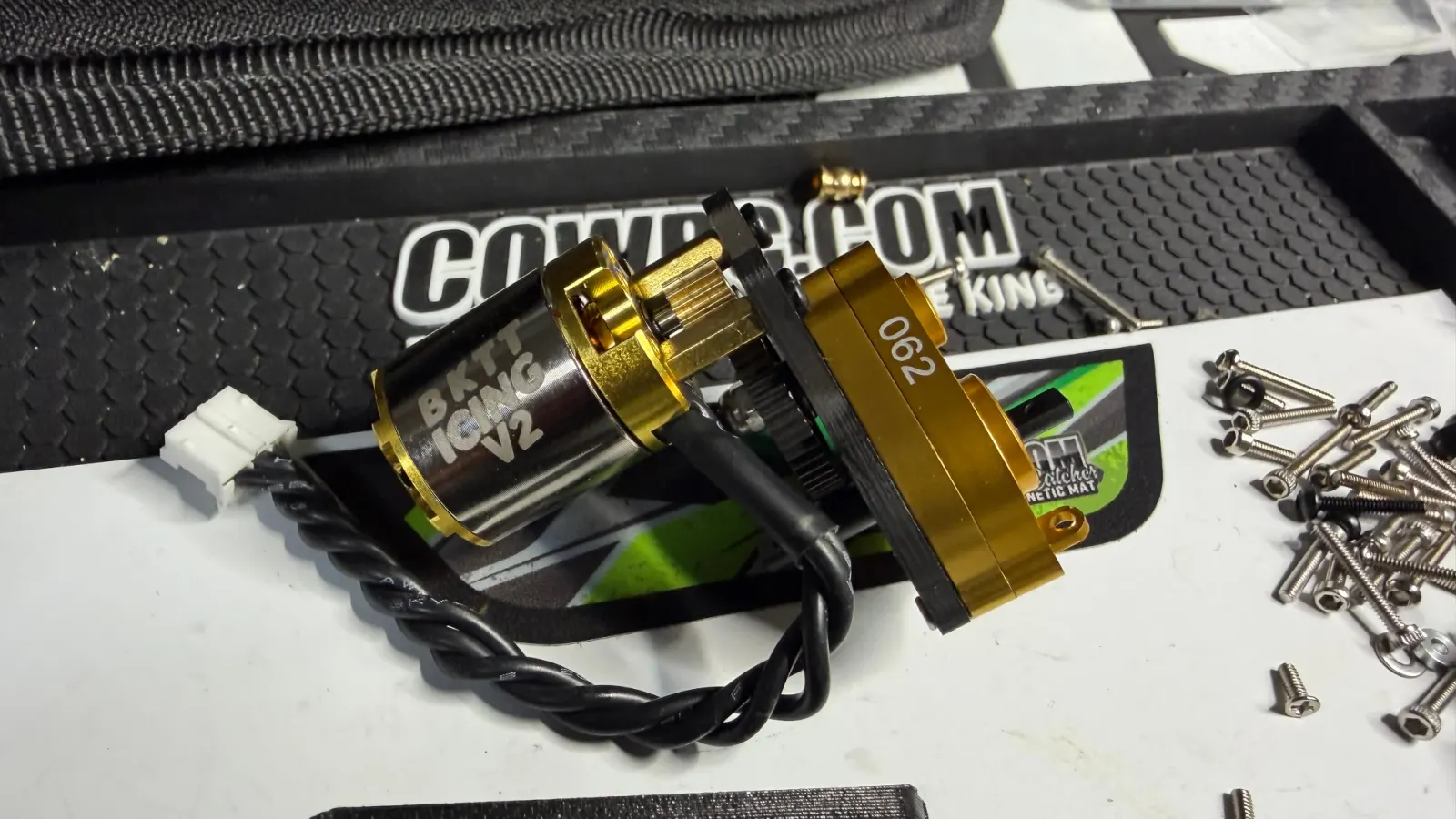
Brushless moves the magnets to the rotor and the copper windings to the outside. There's nothing rubbing on anything except the bearings. The ESC switches the windings electronically through three phases. No brushes, no commutator dust, no pitting. Lifespans are five to ten times longer than equivalent brushed motors.
Sensored vs sensorless (this matters for crawling)
The ESC has to know where the rotor is to fire the correct winding at the correct time. Two ways to find out:
- Sensorless. The ESC reads back-EMF (the voltage the spinning rotor induces in the idle windings) and guesses. Works fine at high RPM. Falls apart at the crawl pace you actually want, where you feel it as cogging, a jerky stutter at low throttle.
- Sensored. Three Hall sensors inside the motor report rotor position over a ribbon cable. The ESC always knows. No cogging, silky from zero RPM.
For an SCX24, sensored is the answer. The exception is Furitek's FOC firmware (the Lizard and Lizard Pro ESCs), which does sensorless smoothly enough that you barely notice. That's why Furitek seems to dominate the SCX24 brushless market despite mostly selling sensorless setups. Recently I've seen posts with users having issues with Furitek ESCs and motors, but I haven't come across that just yet.
What KV actually means
KV is RPM per volt, with no load. A 2700 KV motor spins 2,700 RPM for every volt you feed it. On a 2S LiPo at 7.4V, that's about 20,000 RPM at the motor shaft before any load. Real-world under load is closer to half that. Through stock SCX24 gearing on 1.0" tires, a 2700 KV motor tops out around 7 mph.
KV is set by the wire windings inside the motor. More turns equals lower KV, more torque per amp, less RPM. Fewer turns equals higher KV, more speed, less torque. It's the same physics as brushed turn count, just labeled backwards.
KV ranges for the SCX24
- 1500 to 2200 KV. Comp crawling. Walking-pace top speed, maximum torque. Needs sensored or FOC to stay smooth.
- 2300 to 2700 KV. Trail crawling sweet spot. Controllable slow speed, enough top end to cover ground. Where most builders land.
- 2800 to 3500 KV. Trail plus light bash. Fast on flat, still crawls.
- 3500+ KV. Bashing and speed runs. Loses smooth crawl feel, eats batteries.
Comp builders sometimes drop into the 1700 KV range and use overdriven gearing to get wheel speed back on flat sections.
Brushed turn count for context
Brushed motors use T (turns). More turns means more torque and less speed, opposite of KV. The stock SCX24 motor is 88T. Common brushed upgrades drop to 66T for a mild speed bump while keeping crawl torque. 55T is faster and warmer. 44T and below get into speed-run territory and chew through brushes.
The stock SCX24 electronics problem
The biggest mistake I see on brushless upgrades is assuming you can swap the motor and call it done. The stock ESC is brushed-only and it's integrated with the receiver on a single 2-in-1 board. To go brushless you have to replace the ESC and receiver.
When brushless is worth it
- Heat. Stock brushed runs hot under sustained crawling. Brushless runs cool on long sessions.
- Lifespan. Brushless effectively lasts the life of the truck.
- Smoothness. Sensored or FOC brushless beats brushed at walking pace.
- Coast. Brushed motors have drag even when off. Brushless coasts freely.
- Power-to-weight. A 2700 KV brushless on 2S out-torques a stock 88T brushed by a wide margin.
When brushless isn't worth it
- Cost. A quality brushless combo runs $100 to $230, more than the truck in some cases.
- Drivetrain damage risk. Brushless on stock plastic gears strips them quickly. Budget for hardened steel gears before you flip the switch.
- Wrong KV with stock gearing. A 3450 KV motor on a stock truck is too fast for crawling. Either run a lower KV or underdrive the transmission/diff.
- Casual driving. If you run the truck on weekends only, a quality brushed setup (an INJORA MB100 G2 ESC plus a MofoRC or LGRP brushed motor) is cheaper and lasts plenty long.
My picks
For most builders, the order goes like this:
- Brushed upgrade. INJORA MB100 G2 ESC plus a brushed motor. Around $35 to $45 total. I also like the TorqueBeast, BuzzSaw, and NeoBeasts from MofoRC. Little Guy Racing Parts also has great deals on their Predator, Reaper, and Little Rocket brushed motors. I've run all of the above and carry spares.
- Budget brushless. INJORA MBL32 plus a Purple Viper 2200 KV. Around $60 to $70 combo. Sensored, waterproof. Best bang per dollar in the brushless space.
- Mainstream brushless. Furitek Stinger (Micro Komodo 1212 3450 KV plus Lizard Pro). Around $160. The reference setup most SCX24 brushless builds use. Bluetooth-tunable.
- Comp brushless. Furitek Lizard Pro plus a lower-KV Komodo (1400 to 2200 KV range), or the LGRP Ultimate bundle if you want it pre-packaged.
Full picks with current prices in the best motors and ESC combos buying guide. Step-by-step install in the brushless install guide.
Bottom line: brushless is a real upgrade, and it's a large investment. You can have just as much fun with a brushed setup.