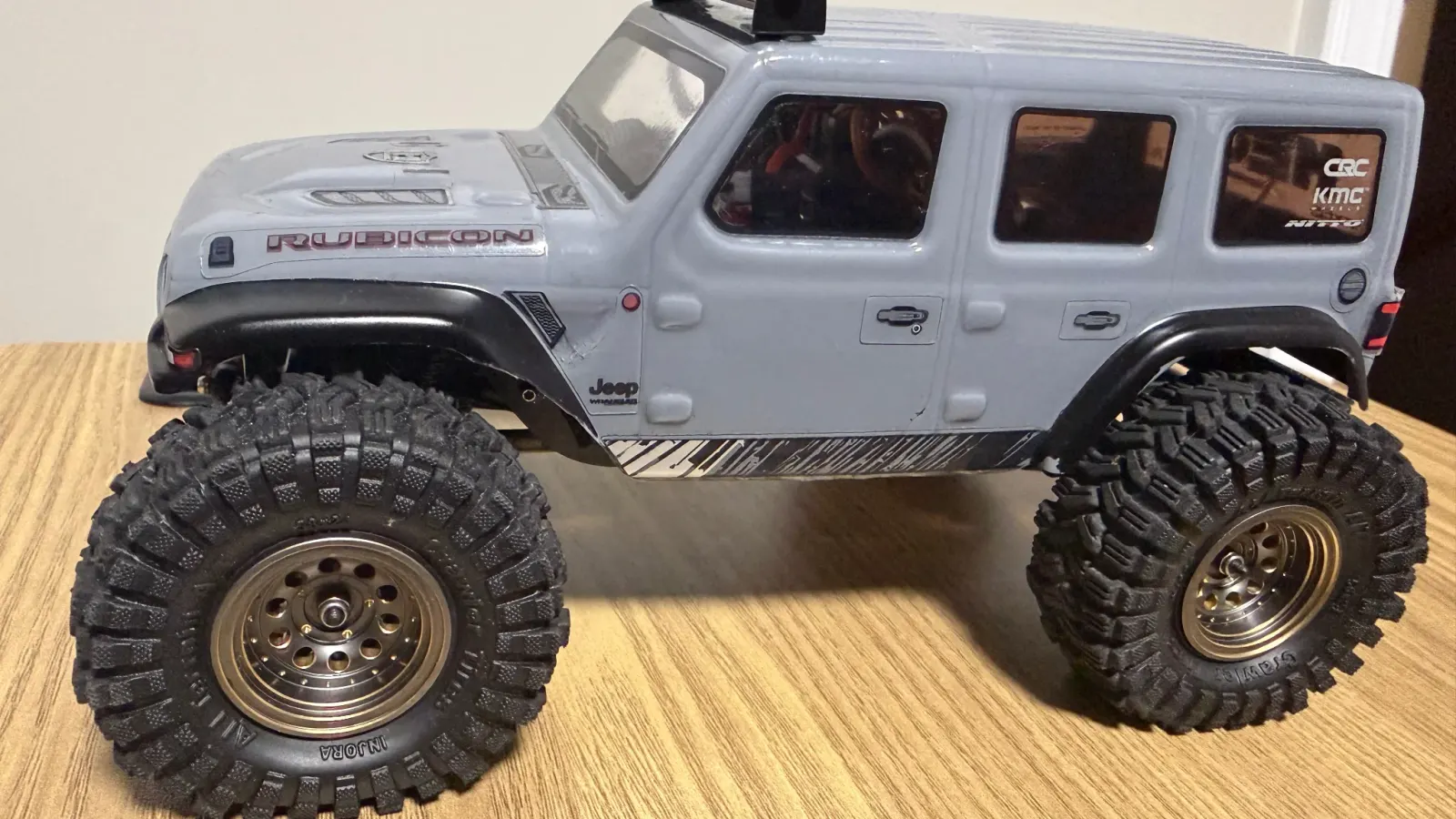
Most builders upgrade their SCX24 in the wrong order. They buy portal axles because portals look cool, then wonder why the truck still won't steer up a ledge. Or they bolt on brushless and strip the stock gears in an afternoon. Across 20+ builds I've landed on the same six stages every time, and they go in a specific order for a reason.
This is the longer companion to the first upgrades guide. If you only do three things, read that one. If you want the full trail-ready build with a budget plan, this is the path.
Stage 0: what stock SCX24 actually is
Out of the box the SCX24 is a $150 RTR that drives well on a coffee table, runs about 15 minutes per pack, and looks decent on the licensed bodies. The 2.4 GHz radio is modern enough. The stock motor will outlast everything else on the truck.
What fails first, in order: the servo gives up under load, the tires slide on rock, the truck tips on side slopes, the stock battery fades under load, the brushed motor feels on or off, and the plastic axles bottom out on real obstacles. Each stage below fixes exactly one of those failures.
1. Servo and steering link
The stock servo is the weakest part on the truck. Every later upgrade adds weight and torque demands the stock servo cannot meet, so do this one first.
My pick is the 3Flow9RC Torrent Mini HV at around $55, paired with their Stainless Steel Servo Horn. The AGFRC A20CLS at around $50 is the safer-priced default and lasts forever. I've had bad luck with eMAX servos from unknown sellers; the counterfeit problem is real and I've had units that were dead on arrival. If you want eMAX, buy from a trusted vendor with a real return policy.
Replace the steering link at the same time. A flexy stock link wastes half the torque of any new servo. A $10 aluminum link from Hot Racing, Treal, or INJORA does the job, or step up to 3Flow9RC's brass steering link if you want weight forward.
More in the servo explainer and the best servos buying guide. Running total: around $70.
2. Tires
Stock SCX24 tires are a hard compound that slides off rock. New rubber is the biggest performance-per-dollar upgrade after the servo, and it costs about $14.
The INJORA S5 Rock Terrain (56×22mm) is the universal beginner answer. Drop-in fit on stock wheels, soft compound, around $14 a pair. The RC4WD Rock Creeper 1.0" is the community gold standard if you want to pay $18 for a slightly grippier compound.
Stay between 57 and 62mm for stock bodies. Above 62mm the C10 in particular will rub without fender trimming or hex extenders. Running total: around $85.
3. Brass weights
Brass lowers the center of gravity and plants the front end. The trap is overdoing it: too much brass strains the servo and the plastic drivetrain. Stop somewhere around 40 to 60 grams of added weight.
My order:
- Brass wheel weights. Start here. Cheapest, biggest improvement.
- Brass knuckle weights. Reassess after these. The truck feels like a different rig.
- Brass diff covers. Front only is usually enough.
- Brass skid plate. Optional.
Skip aluminum knuckles. They're lighter than the stock plastic and take weight away from exactly where you want it. Running total: around $115.
4. Battery
The 350 mAh stock pack is fine to learn on. A quality 2S pack from a known brand holds its voltage better under load, which matters once you go brushless in the next stage. Buy two or three packs so you're not waiting on a charger between sessions.
I run Tattu 300 mAh 2S packs (2S LiPo, JST-PHR plug, around $7 each on Amazon). For a more premium option, the Tiny Terrains 200 mAh 2S (around $13) is lighter and made for the SCX24 and SCX30. Pair them with a real balance charger; the stock USB brick is slow at best and a fire risk at worst. I use a Tenergy TB6-B. Running total: around $160 with two packs and a charger.
5. Brushless motor and ESC
This is where most builders get pulled toward brushless too early. Two things have to be true before you bolt brushless on: you have a real battery (Stage 4), and your drivetrain can handle the extra torque. Brushless on stock plastic axle gears strips them within hours, so if you go brushless, plan on doing Stage 6 axles right along with it.
Three ways I'd go, from easiest to most custom:
- Entry combo. The Hobbywing QUICRUN WP Mini24 Combo (around $80) pairs a waterproof Mini24 ESC with a 1621SL 3500Kv motor. The simplest way to get brushless on the truck.
- Plug and play. The Furitek MicroSilk 2025 Brushless Power System (around $100) pairs the MicroPython ESC with a MiniKomodo motor, made for the SCX24.
- Custom. This is what I like doing on my own builds: a JK RC Performance transmission, a brushless motor of my choice, and a Furitek ESC. More money and more work, but you pick every piece.
Two warnings. Stay on 2S unless you're sure your ESC and motor can handle 3S; 3S will pop most stock-class ESCs. And on post-2021 trucks (Bronco, Gladiator, late JLU) the 2-in-1 board has no separate channel 2 port, so a standalone ESC means a new receiver too. Running total: around $240 to $260 with a combo, more for a custom setup.
6. Axles (or a new chassis)
Stage 6 is where builds start to look different from each other. Upgraded metal axles replace the fragile plastic housings, which matters once you've gone brushless. Portals get most of the attention, but they're not the default. I like running different axles across my builds, and only one of mine has portals (or a mullet setup). Pick the axle that fits how you drive.
The other path is a new chassis. The two I love are the Mazz Designs Cheat Code v3 (around $75 in carbon, $85 in titanium) and the NW Chassis Works Athos (around $70). A lower chassis drops the center of gravity and opens up shock mounting geometry. Great if you're chasing flex and articulation, less great if you're trying to clear bigger obstacles.
Deep dives in all about SCX24 axles and best LCG chassis. Your running total from here depends on the axles you pick.
When to stop
Most trail drivers do not need Stages 5 and 6. Honest truth from 20+ builds:
- Stages 1 to 3 turn a frustrating truck into a genuinely capable one. This is the sweet spot for casual drivers.
- Stage 4 is basically free. Always do it.
- Stage 5 is for builders who want comp finesse, want to bounce rocks, or are bored of the brushed feel. Trail drivers can skip it.
- Stage 6 is mostly geometry. If you're still brushed and your local terrain doesn't high-center a stock rig, you don't need it. If you went brushless, metal axles stop being optional.
Stop wherever the truck satisfies you. There's no prize for finishing all six.
Budget summary
- Stage 1 (servo + link): $60 to $90
- Stage 2 (tires): $15 to $30
- Stage 3 (brass): $25 to $80
- Stage 4 (battery + charger): $50 to $90
- Stage 5 (motor + ESC): $80 to $100 for a combo, more for a custom setup
- Stage 6 (axles or chassis): $70 to $85 for a chassis; axles vary a lot by style and material
Realistic mid-range trail-ready build: around $450 to $550 all-in, counting the $150 truck. Comp build with premium axles: $700 to $900.
Log each stage in your wishlist as you read so you don't lose track of what you decided. Move parts to Ordered when you place the order and Installed once they're on the truck. The total cost will roll up automatically.