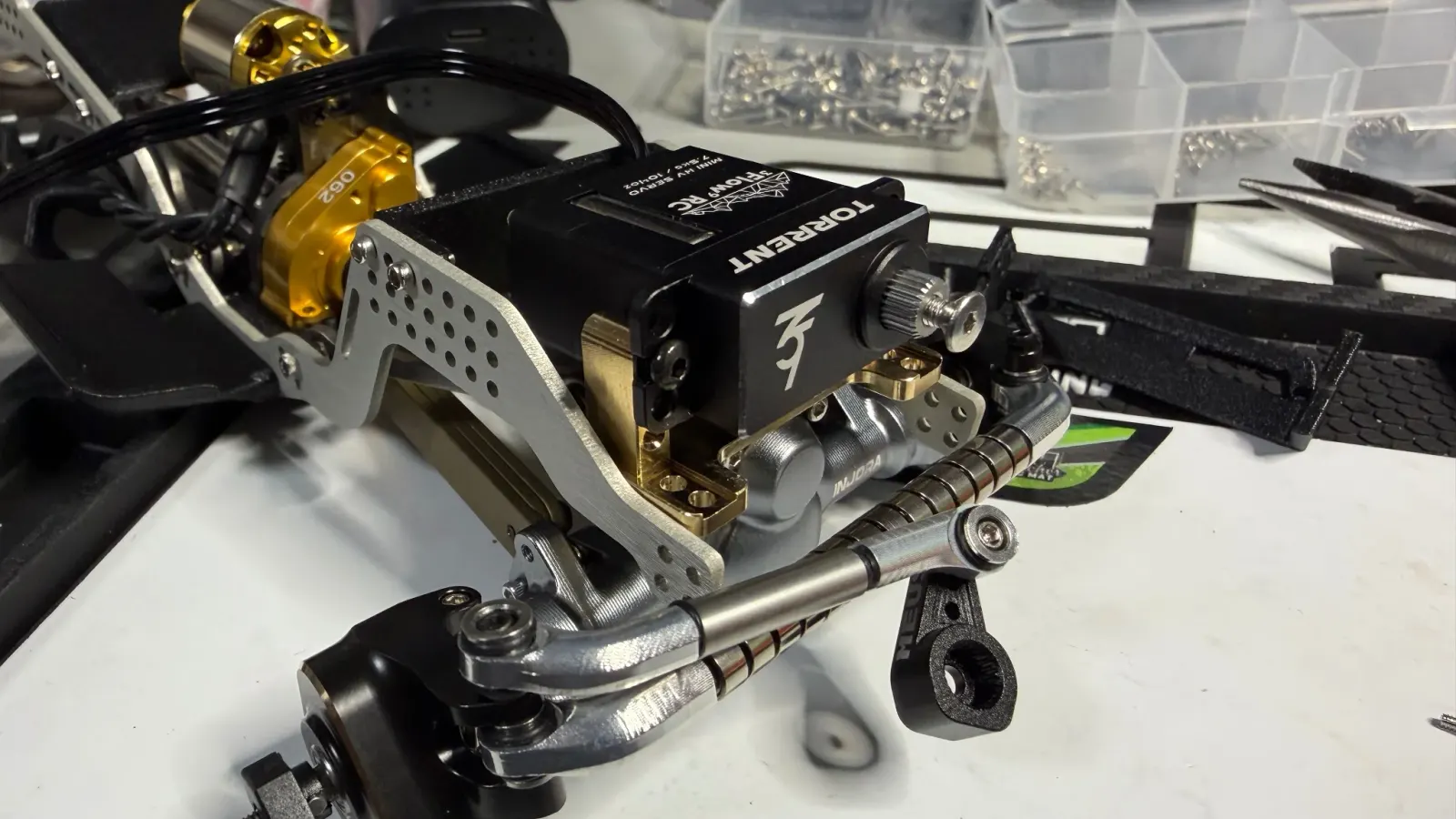
The first real upgrade I ever bought for an SCX24 was an eMAX servo. The community told me to. I ordered the cheapest one I could find on Amazon and it was a disaster: weak, noisy, dead within an afternoon. Almost certainly a counterfeit. I went straight to a 3Flow9RC after that and never looked back.
The stock SCX24 servo is the weakest part of the truck. It will be the first thing you replace, and it's the single biggest improvement of any upgrade in my opinion. This article explains what a servo actually does, what the spec numbers mean, why the stock one fails, and how to pick a replacement.
What a servo actually does
A servo is a small motor with a gearbox, a position sensor, and a control board, all sealed in one case. The radio sends a signal that says “turn to this angle.” The servo's board compares that signal to where the output shaft actually is, and runs the motor until they match. On an SCX24, the servo connects to a horn, a drag link, and the steering knuckles. Stick input becomes steering angle.
The two numbers that matter
Every servo lists two specs: torque and speed.
Torque is measured in kg-cm. A 10 kg-cm servo can hold 10 kg of force at 1 cm out from the shaft. For an SCX24, under 2 kg-cm is stock-class and fails fast, 2 to 4 kg-cm is entry upgrade territory, 5 to 8 kg-cm is solid for a trail rig, and 9 to 15 kg-cm is comp-grade.
Speed is measured in seconds per 60 degrees of rotation, no load. Lower is faster. For crawling, torque matters more than speed. You want the servo to hold pressure on the steering, not whip back and forth. Anything in the 0.08 to 0.12 second range is fine.
My target for an SCX24: around 7 to 11 kg-cm of torque at 7.4V, metal gears, coreless or brushless motor, HV-capable.
Why the stock SCX24 servo fails
Don't quote me but I believe the stock servo is around 1.5 to 2 kg-cm of torque with plastic gears and a cored brushed motor. That's about a third of what the truck needs once you've added grippy tires. The failure modes I see most:
- Plastic gear strip. Hardest side-load on a ledge shears the output gear teeth. First weekend on real rock is when it usually happens.
- Burnout under bind. Hold steering against a stop or a stuck wheel and the motor stalls.
- No water resistance. Mud, snow, or even heavy condensation will kill it.
- Not enough torque for an upgraded rig. Add brass, larger tires, and a heavier battery and the stock servo can't turn the wheels under load.
The other reason to swap the servo and not just the gears: the stock servo uses a proprietary spline, so almost no aftermarket horn fits it.
What a good SCX24 servo looks like
The minimum spec sheet I look for:
- Motor: coreless minimum, brushless preferred.
- Gears: metal, hardened steel ideal.
- Torque: 7 kg-cm or higher at 7.4V.
- Speed: 0.08 to 0.12 seconds per 60 degrees.
- Voltage: HV-capable (6 to 8.4V).
- Bearings: dual ball bearing on the output shaft.
- Spline: 25T mini, 4.9mm shaft. This is the SCX24 standard and gives you the widest horn selection.
- Waterproofing: O-ring sealed case if you run in wet conditions.
Form factor and mounting
SCX24 servos come in two footprints. The eMAX-style 12-gram size (23 × 11.5 × 24mm) and the larger size (around 32 × 12 × 27mm). Larger servos hit higher torque numbers but need a wider mount. There are lots of brands that offer adjustable servo mounts.
Always check that the mount in the box matches your servo's footprint and that the horn matches the spline. 25T mini is not the same as 25T standard.
Voltage and the stock BEC
Servo torque and speed scale with input voltage. Most upgrade servos are rated 6 to 8.4V (“HV”). The stock SCX24 2-in-1 board feeds its servo from a 6V BEC, which means an HV servo on a stock electronics setup runs at reduced spec. If you upgrade to an aftermarket ESC (Furitek, INJORA MBL32, Hobbywing) you can switch the BEC to 7.4V and get the marketed numbers.
Don't feed a 6V-only servo on an HV setting. It will burn out. I've done it by accident.
My picks
I run two servos across most of my builds:
- 3Flow9RC Torrent Mini HV at around $55. Around 7 kg-cm of torque, programmable, metal gears, excellent build quality. Pair it with their Stainless Steel Servo Horn. Note the horn uses M2 size threads.
- AGFRC A20CLS at around $50. Programmable, dual ball bearing, metal gears, around 7.5 kg-cm.
Note: I've found that many of the popular servo brands are AGFRC under the hood. I'll also buy servo re-gear kits to save money when one strips.
The eMAX counterfeit problem
eMAX makes good entry-level servos. The problem isn't the brand, it's the supply chain. Knock-off eMAX servos circulate widely on AliExpress, eBay, and through third-party Amazon sellers. They die quickly, the seller won't refund, and the user reviews on the listing get replaced when the seller swaps SKUs.
Buy from a real hobby retailer or skip eMAX entirely. The extra $30 for an AGFRC or 3Flow9RC buys you a real servo with no sourcing risk.
Install mistakes to avoid
- Running an HV servo on a 6V BEC. You get half the torque you paid for. Match the BEC voltage to the servo's rating.
- Buying horns on spline count alone. 25T mini and 25T standard are different. Match SCX24-specific horns.
- No threadlocker on the horn screw. The horn comes loose mid-trail and you lose steering.
- Not centering the servo before installing the horn. Causes asymmetric steering travel.
Walkthrough of the actual install in the servo install guide. If you want a step further on torque, speed, and motor types, see the buying guide for the full shortlist with prices.