
I've put serious miles on the major SCX24 axle upgrades. This guide is opinionated on purpose. The category is full of overlapping products at confusing price points and aggressive marketing language. If you read the all about SCX24 axles first, you already know how stock axles fail and what an upgrade fixes. This guide tells you exactly what I buy.
The four axles I actually run
In order of how often I reach for them on a new build:
- MEUS Racing Isokinetic V2. Around $77 in metal, $56 in nylon. The value king. CVD straight axle, 52 degrees of steering angle, +5mm wider per side. The metal version is what I default to. As of March 2026 I've also been running the nylon version and it goes over rocks easier than metal, costs less, and holds up well to trail use.
- MofoRC X15. Around $75 in nylon, $150 in billet aluminum. I run both. Straight axle, +5.5mm per side. Hand-built quality, excellent finish. The step up from MEUS when you want a touch more refinement without going into brass-money premium territory.
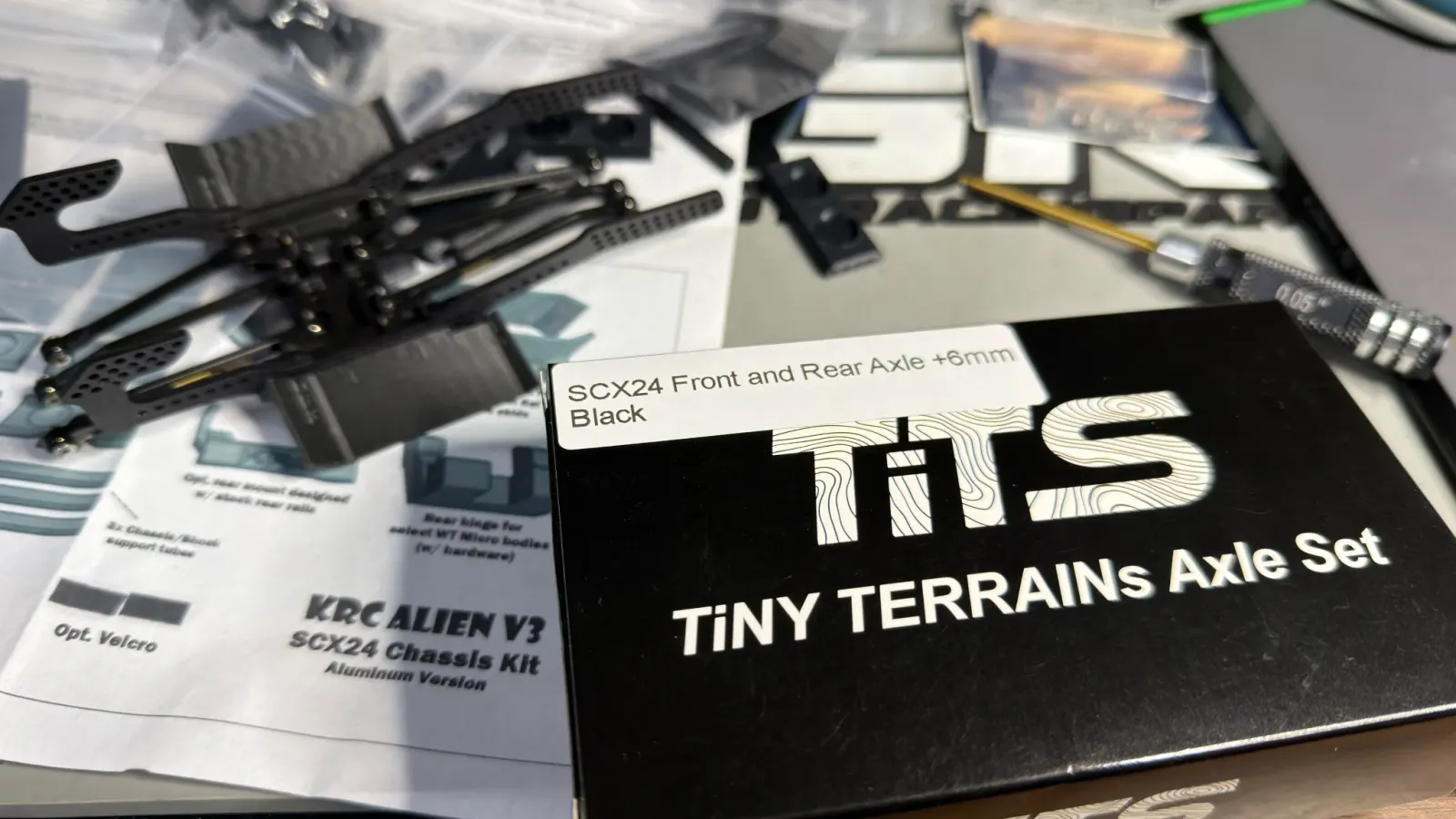
- TiTS 12Cv2 / 12Cv3. Around $84 to $109. Premium straight axle from a small US shop. Comp-grade machining, holds up under sustained brushless use without flexing. What I run on builds where I'm chasing consistency across multiple comp sessions.
- LGRP Super 8. Around $130 for the V2 set. Straight axle with U-joints, +8mm per side. The widest of the four. Reaches lines that narrower axles can't. Premium machining, premium price.
All four are straight axles (the hub stays on the axle centerline). They're the upgrades you actually want for steering angle and durability. Portals are a different tool for a different problem; more on that below.
Pair them with 3Flow9RC steering links
Whichever of the four axles you buy, pair it with 3Flow9RC rolling steel steering links. They make links sized for each of these axle setups. They're pricey, but the precision and the weight forward are real, and the steel construction won't flex on technical lines. A flexy stock link wastes both the steering angle and the new servo torque you just paid for.
What you're actually buying
A full axle kit for the SCX24 is a complete drop-in axle assembly, not just a gearbox you add to your existing housing. In the box:
- Two fully assembled axle housings (front and rear)
- Worm-gear differential, usually 2/16T stock-ratio (some kits offer overdrive ratios)
- Inner axle shafts, usually CVDs or U-joints
- Outer stub shafts
- Steering knuckles (front)
- Wheel hexes (1.0" 7mm hex)
- Bearings throughout
What's not in the box: the servo (you reuse yours, but the mount may differ), the motor mount, the chassis links (you reuse, but lengths may need adjustment), and the driveshafts to and from the transmission. Plan ahead for these.
When portals make sense
Portals lift everything between the hubs for extra ground clearance and add a wheel underdrive. Only one of my builds runs them (or a mullet setup); the rest are on the straight axles above. If your local terrain keeps high-centering the truck on the diff pumpkin, portals are worth a look. Expect a bigger install (often new driveshafts and a new servo mount), more fender rub on stock bodies, and less top speed. The all about axles guide covers how they work.
On a tight budget
INJORA Planet axles (+4mm per side, around $40 to $63) are the budget option. Despite the name, they're straight axles, not portals. Fine for stock-class trail use; if you're going brushless, I'd save up for one of the four above.
How to choose between the four
The honest decision tree:
- First axle upgrade, on a budget: MEUS Isokinetic V2 nylon. Around $56, drives well, easy install.
- First axle upgrade, going metal: MEUS Isokinetic V2 metal. Around $77.
- Step up from MEUS: MofoRC X15. Better finish, hand-built quality, around $75 nylon or $150 billet.
- Comp build: TiTS 12Cv2 or 12Cv3. Holds tolerances under hard use. Around $84 to $109.
- Widest stance possible: LGRP Super 8. +8mm per side. Around $130.
- You keep high-centering on the diff: that's the case for portals (see above).
Where axle upgrades sit in the overall plan: see the staged upgrade path.