
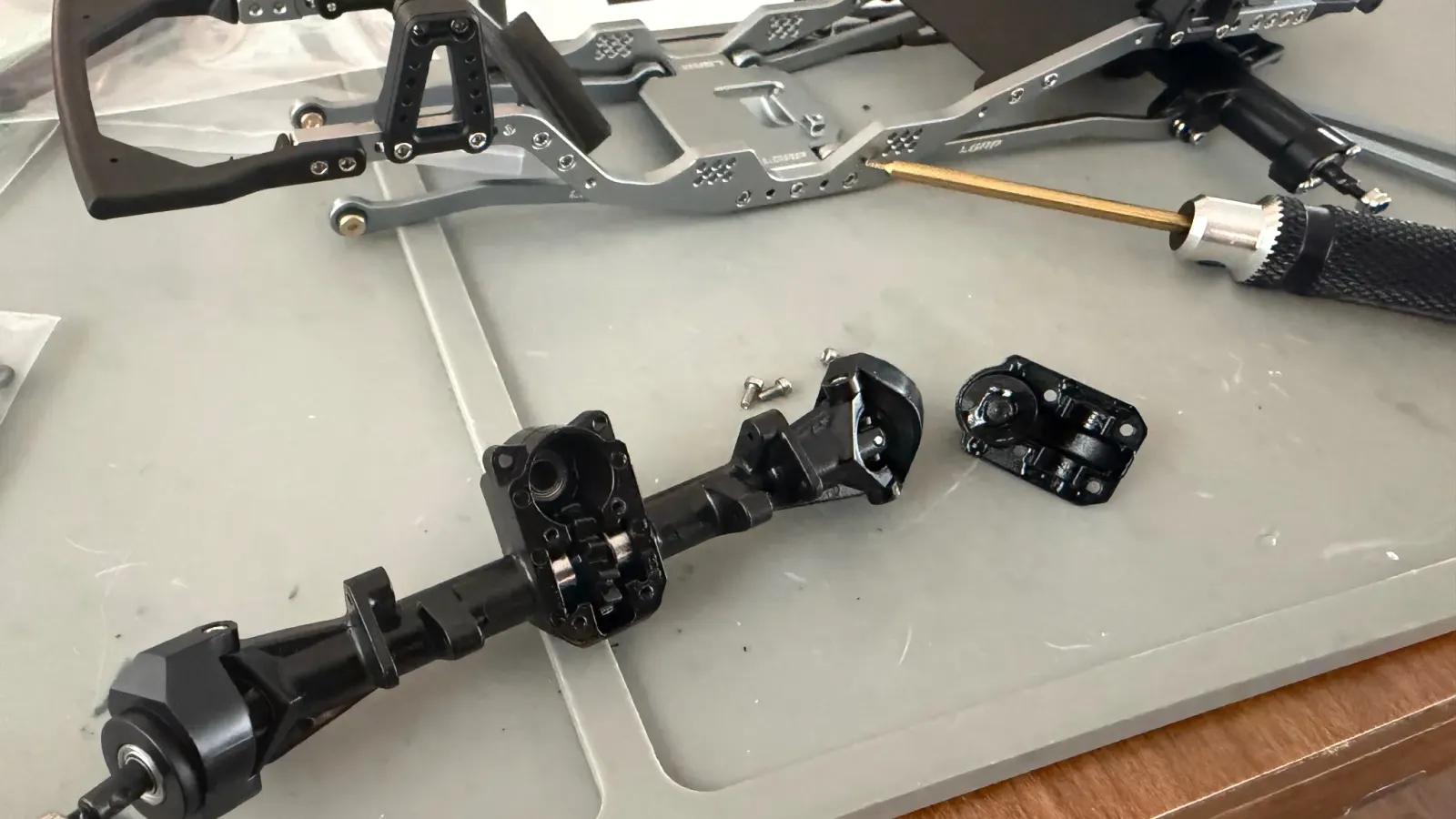
The axle shaft inside an SCX24 is either a dogbone or a CVD. The stock truck uses dogbones. Most upgrade axles use CVDs. Knowing the difference is the difference between a truck that loses dogbones on a steep ledge and one that just keeps driving.
What a dogbone is
A one-piece drive shaft with a flared knob at each end. The knob sits in a cup (the diff outdrive on the inside, the axle stub cup on the outside). A small cross pin or molded boss in each end engages the cup so torque transfers when the cup rotates.
It's a primitive universal joint. Two sliding lobe-in-cup connections in series. Each one is a single-axis pivot, so the shaft has to plunge in and out of the cup as the suspension cycles and as the knuckle rotates. There's no true constant-velocity geometry, so the output speed accelerates and decelerates through every rotation any time the cup is at an angle.
Pros: cheap to make, easy to service, tolerates a little wear before failing.
Cons: velocity isn't constant under angle, friction grows with angle, the pin is the weakest point, and at full droop or full steering lock the knob can walk far enough out of the cup to pop free.
What a CVD is
Constant Velocity Drive. A true CV joint that delivers the same rotational speed at the wheel as at the diff regardless of angle. RC CVDs come in two flavors: splined ball-and-cage (the proper Rzeppa style, expensive) and pinned U-joint with a sliding inner shaft (more common at SCX24 prices). Both fix the dogbone problems.
Key traits:
- No velocity pulsing under angle. The wheels turn smooth at any steering lock.
- Higher angle ceiling before bind. Most SCX24 CVDs are rated 39 to 52 degrees vs. 27 for the stock dogbone.
- The shaft splines into the outer stub. It can't pop out under droop or steering.
- Load goes through a hardened cross pin in a yoke, not through a thin lobe in a sliding cup. Higher torque before failure.
- More parts means more cost. A dogbone is $7. A CVD set is $25+.
Marketing terms blur. CVD, universal joint axle, isokinetic, double-joint, 3-section CVD all describe variations on the same idea. MEUS's Isokinetic line is a 3-section CVD with two pivots in series for extreme angle. INJORA's double joint is a sliding pinned U-joint, not a true Rzeppa, but it delivers most of the same benefits at a lower price.
What stock SCX24 shafts actually fail at
Plastic dogbones in the front, plastic stub-axle shafts in the rear. Both are molded nylon-class plastic with a small steel cross pin. They fail in three ways:
- Pin shear. Heavy load (a tire stuck on a rock, brushless punch through stock gears) snaps the steel cross pin. Drivetrain stops.
- Lobe wear. The plastic lobe rounds off over time. Symptoms: knocking sound at slow speed under load, increasing slop, eventual no-drive.
- Pop-out. At full droop or full steering lock the knob walks out of the cup. Common on jumps or technical ledges where the suspension cycles past where the geometry holds.
When to upgrade
Three signals it's time:
- You've lost a dogbone on the trail. Annoying. Carry spares or upgrade.
- You've gone brushless or are about to. Brushless torque shears the cross pin or strips the lobes within hours of running. Hardened steel CVDs or at minimum hardened steel dogbones are mandatory before you flip the brushless switch.
- You want more steering angle. Stock dogbones bind at 27 degrees. CVD-equipped axles open up to 39 to 52 degrees, which transforms how the truck takes technical lines.
If you're running stock-class power and only crawl casually, hardened steel dogbones are a cheap upgrade ($15 to $25) that buys you the durability without the full CVD cost. They'll still bind at 27 degrees, but they won't shear or pop out.
The picks
For SCX24 CVD shafts (stand-alone, fits stock axle housings):
- INJORA double-joint hardened steel at around $20 to $30. Best budget option. Most of the benefit of a true CVD for half the price. The community consensus on RCCrawler is to buy the D-shape version (the one with a flat on the shaft for the set screw) rather than the round-hole version that relies on tiny grub screws for retention. D-shape is more durable.
- LGRP hardened steel CVD set at around $35 to $45. The mainstream upgrade.
- Treal 7075 aluminum CVDs at around $40 to $55. Lighter than steel, comp-friendly.
- Mofo RC hardened steel CVDs at around $40 to $50. Excellent machining quality.
- EXO Gr5 titanium U-joint shafts, premium tier. Heat-treated grade 5 titanium with hardened steel pins and barrels. Available in stock length or LGRP Super 8 length, which is the killer feature if you're running Super 8 axles. Rated for 55 degrees of steering. Install note: pull the outer bearing in the axle tube before assembly, or the shaft will bind on it and break. I've heard great things from builders running these on Super 8 axles.
For full CVD-equipped axle replacements (housing + shafts):
- MEUS Racing Isokinetic V2 (metal) at $90 to $130. 3-section CVD with 52 degrees of steering angle. The value king. This is my default on most builds.
- LGRP Spider 9. Premium machining, comp-grade.
- Mofo RC. Hand-finished, $150+. The premium tier.
CVDs versus portal axles
Both fix things on the SCX24, differently:
- CVDs (or isokinetics) fix the dogbone problem and open up steering angle. Keep stock-class ground clearance. Retain top speed.
- Portals add 6 to 10mm of ground clearance and 25% wheel underdrive. Better for trails where you keep high-centering.
I run isokinetics and straight axles with CVDs, not portals. The trade-offs and full reasoning are in the all about SCX24 axles explainer.
Where shafts and axles sit in the overall plan: see the staged upgrade path. Stage 6 territory, not first upgrades.