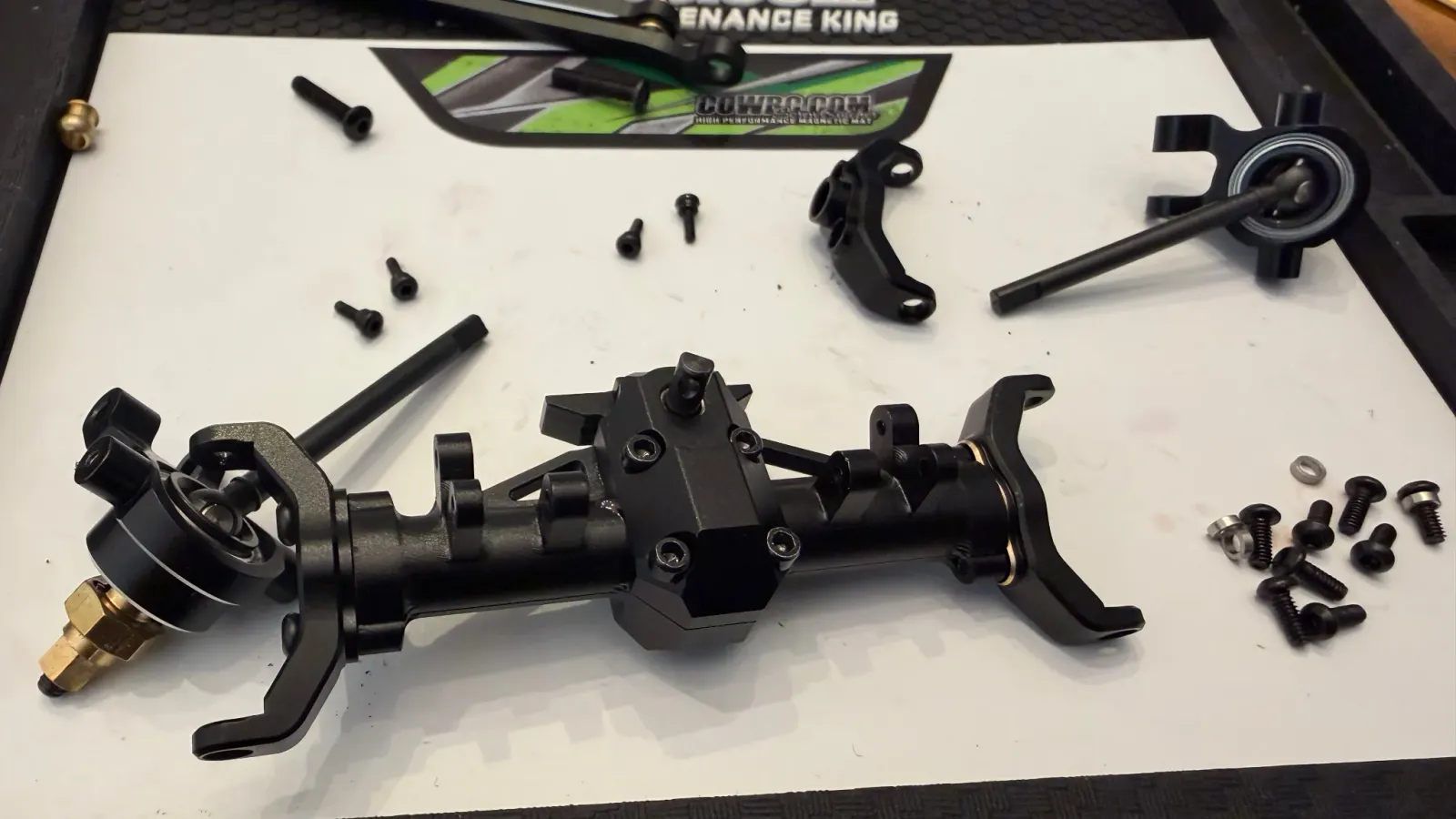
Axles are the foundation of how the truck drives. They determine steering angle, ride height, drivetrain durability, and how cleanly power gets to the wheels. The SCX24 ships with plastic everything, which is fine in the beginning but you'll soon want to upgrade this part. This article covers what stock axles are, where they fail, the four axle upgrades I actually run, and the marketing versus the reality of the “portal” category.
Upfront: portals aren't my default. Only one of my builds runs them (or a mullet setup), and I like running different axles across the rest. The four picks below are all straight axles with CVDs or U-joints. They give me the steering angle, durability, and wider stance I want without the install complexity or top-speed trade-off that portals bring. More on why below.
The short version: what I actually run
I've put serious time on four axle upgrades across my builds. In order of how often I reach for them:
- MEUS Racing Isokinetic V2. Around $77 in metal, $56 in nylon. The value king. CVD straight axle with 52 degrees of steering angle. My default on most builds. As of March 2026 I've been running the nylon version too and it goes over rocks easier than the metal version, and it's cheaper.
- MofoRC X15. Around $150 billet, $75 nylon. I run the metal version and just got the nylon. Straight axle, +5.5mm per side. Hand-built quality, excellent finish, comp-friendly.
- TiTS 12Cv2 / 12Cv3. Around $84 to $109. Premium straight axle from a small US shop. Comp-grade machining, holds up under brushless, and the silver ones look great.
- LGRP Super 8. Around $130 for the V2 set. Straight axle with U-joints, +8mm per side. The widest of the four. Reaches lines that narrower axles can't. Premium machining, premium price.
Whichever of the four you buy, pair it with 3Flow9RC rolling steel steering links. They make links sized for each of these axle setups. They're pricey, but the precision and the weight forward are real, and the steel construction won't flex on technical lines.
What stock SCX24 axles are
Two small straight axles, each housing a worm-drive differential. 2T worm meshing a 16T worm gear (so no over- or underdrive). Plastic dogbones up front, plastic axle shafts in the rear, plastic knuckles, plastic diff covers. Around 27 degrees of steering angle. Around 12mm of ground clearance under the pumpkin, which is the lowest point on the truck.
Weak points, in order of how often they fail:
- Plastic dogbones strip or pop out at full lock under load.
- 2/16T worm gear strips on the rear under brushless or heavy brass loads.
- Diff pumpkin high-centers on ledges and stair-step rocks.
- Limited steering angle at 27 degrees, which feels tight on technical lines.
- Plastic flex in the knuckles and diff cover costs precision at high bind angles.
Background on the dogbone vs. CVD shaft question is in the CVD vs. dogbones explainer.
What changes when you upgrade axles
The four picks above all share the same wins:
- More steering angle. 41 to 52 degrees vs. 27 stock. Transforms how the truck takes tight technical lines.
- No more dogbone pops. CVD or U-joint shafts splined into the outer stub. They don't walk out under droop or full lock.
- Wider stance. 4 to 8mm per side. Better stability on side slopes.
- Hardened gears. Brushless and heavy brass don't strip them.
- Better fit and finish. Metal housings, proper machining, predictable behavior.
What “portal” actually means
A portal axle moves the wheel hub below the centerline of the axle tube and adds a small gearbox at each wheel to bridge the offset. Power goes from the diff to the axle shaft to a portal box at the end of each axle housing, through a pair of meshing gears, and out to the wheel hub. Two things happen:
- Everything between the hubs is lifted. The diff pumpkin, which is normally the lowest point on the truck, is now well above the contact patch. That's the ground clearance gain.
- The portal gears add a final stage of reduction at the wheel. Usually 25% on RC scale portals. The upstream drivetrain sees less torque for a given output at the tire.
Why portals aren't my default
Portals are a real upgrade. I'm not saying they don't work, and I do have one build running them. On most of my builds I just don't need them. A few reasons:
- The steering angle gain is what I actually want from an axle upgrade. The MEUS Iso at 52 degrees fixes the worst stock complaint without changing the rest of the truck's character.
- Ground clearance is easier to gain elsewhere. Taller tires, a chassis that tucks everything up off the belly, or just running brass at the wheels for stability all change how the truck approaches obstacles. Portals are one way to gain clearance, not the only way.
- The 25% wheel underdrive bothers me on flat sections. I want the truck to cover ground between technical lines. Portals make that slower.
- Install is more involved. New driveshafts, new servo mount, sometimes new links. The straight-axle upgrades I run are closer to drop-in.
- Body fitment. Wider stance plus taller housing pushes tires into stock fenders, especially on the C10.
None of this is universal. If you keep high-centering the truck on your local rocks, portals fix that. The best axles buying guide covers the options. They're just not my default.
Watch the marketing
Several “axle upgrades” for the SCX24 get called portals but aren't. They're re-styled straight axles, often with better internals and wider stance, but the hub is still on the axle centerline so they don't add ground clearance. This isn't a knock on the products. It's a knock on the marketing. Buy them for what they actually are.
- MEUS Isokinetic. Straight axle with CVD shafts and 52 degrees of steering. Excellent upgrade, not a portal.
- MofoRC X15. Straight axle, +5.5mm per side.
- TiTS 12Cv2 / 12Cv3. Premium straight axles.
- LGRP Super 8. Straight axle with U-joints.
- INJORA Planet Axles. Not portals. Re-styled straight axles with a planet-themed diff housing, hardened worm gear, double-joint shafts. +4mm per side. Beginners get tricked by the name.
- INJORA ProSteer. Also a straight axle.
If the spec sheet doesn't explicitly say “portal,” “drop gear,” or “hub reduction,” it's a straight axle.
Other things to budget for
An axle swap touches more than just the axles. Plan for:
- New driveshafts. Most upgrade axles change the pinion location. Stock driveshafts may be the wrong length or angle.
- New servo mount. Stock servo mounts reference the stock axle housing. Many upgrade axles need a different mount. Some kits include one; many don't.
- New links. Wider stance changes link geometry.
- Hex extenders or fender trimming. The wider stance can rub on stock fenders, especially on the C10.
- 3Flow9RC steering links. As above. The pairing that makes the steering angle gain actually pay off.
Where this sits in the build plan
Axles are Stage 6 in the staged upgrade path. Not first upgrades. A $100+ set of axles does nothing for you if the wheels won't turn or the tires won't bite. Get the servo, tires, brass, and battery sorted first. If you're going brushless, do the axles at the same time; stock plastic gears won't survive it.