

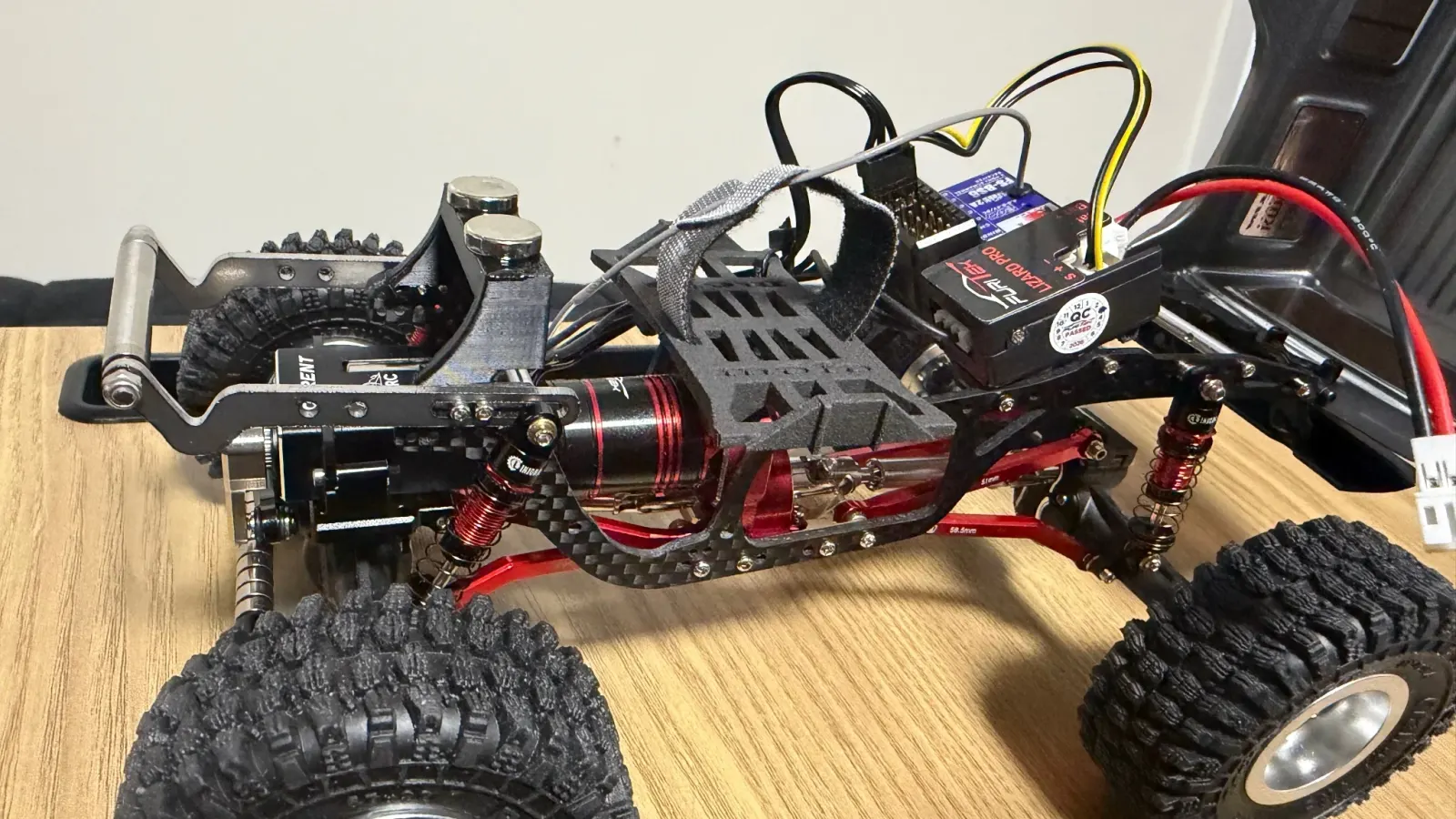
The most dangerous thing in the SCX24 box is the charger. The USB brick that ships with the truck works, but there are documented reports across forums and Reddit of these chargers overheating and even catching fire. Multiple builders have abandoned the stock charger after watching it run hot or after reading a thread about one that shorted. This article walks you through what the stock setup actually is, what to replace it with, and how to handle LiPo batteries without burning down your living room.
What ships with the truck
Every current SCX24 RTR includes a Spektrum 2S 7.4V 350mAh 30C LiPo pack (SPMX3502S30) with a JST-PH 2.0 discharge plug and a JST-XH balance lead. The charger is a Spektrum USB LiPo charger (SPMXC0030). It plugs into the balance lead (not the discharge plug, which trips up beginners) and runs off USB-A power. It does balance-charge, but it has no display, no storage mode, no charge-rate control, and no way to recover an over-discharged pack. Charge time is around 45 to 60 minutes per pack.
LiPo basics, fast
A LiPo cell sits at 3.7V nominal, 4.2V fully charged, and 3.3V at the typical low-voltage cutoff. Below 3.0V you start permanently damaging the cell. Below 2.5V most chargers will refuse to even attempt a recharge.
- S count is cells in series. A 2S pack is two cells. Stock SCX24 packs are 2S.
- mAh is capacity. Bigger number, more runtime, more weight.
- C rating is current capability. Capacity times C is roughly the continuous current: a 30C 350mAh pack gives around 10.5A, a 75C 300mAh pack around 22A, a 20C 200mAh pack around 4A. Low C packs are fine on light builds; heavier rigs pushed hard want more headroom.
- Balance lead (JST-XH on RC LiPos) lets the charger see each cell individually so it can equalize them. Without balance charging, cells drift apart, one eventually overcharges or overdischarges, and bad things happen.
- Storage voltage is 3.8V per cell. Leave a pack fully charged for weeks and it puffs. Leave it empty and it dies. A real charger has a one-button storage mode.
Why the stock charger isn't enough
Three problems:
- No storage mode. If you charge a pack and don't drive for a week, the pack sits at 4.2V per cell and ages fast.
- No safety margin. Documented fire reports, especially with multiple packs over the same brick or USB hub.
- Slow. 45+ minutes per pack, one pack at a time.
The charger I run
Tenergy TB6-B. It can feel confusing the first time you set it up, but a quick run through the manual or a YouTube video sorts it out fast. After that it's straightforward. Balance-charges any LiPo, has a real storage mode, has discharge for cycling old packs, and handles everything from 1S to 6S so it'll grow with you if you ever move to bigger trucks.
Other solid options at around the same price: ISDT Q6 Nano (pocket-sized, smart), HOTA D6 Pro (charges two packs at once, premium pick at $80 to $110), or any HRB balance charger if you want budget. Whatever you buy, it needs balance charging, storage mode, and the ability to set the charge rate. Avoid anything that just plugs into the wall and starts dumping current.
What you'll need beyond the charger
- A power supply. Most balance chargers need 12V DC input. A 12V 5A wall brick is plenty for SCX24-class packs.
- A PH 2.0 adapter cable. Your charger has banana plugs or XT30/XT60 output, not the small JST-PH 2.0 the SCX24 pack uses. ToolKitRC sells one for around $5. You only need one; it adapts everything.
- A LiPo storage bag or ammo can. Cheap, around $10. Charge inside it. If a pack ever vents, it contains the damage.
Battery picks
What I run, and the alternatives (all 2S; the 1100mAh Gens Ace needs a bigger tray):
- Tattu 300mAh 2S 75C. My pack. Around $7, 15.5g, 2S LiPo with a JST-PHR plug.
- Tiny Terrains 200mAh 2S. The premium option. Around $13, 20C, the lightest pack here.
- EcoPower “Trail” 2S 450mAh 30C. Around $22 to $27. Drop-in stock tray fit, +25% runtime over stock. Most-recommended trail pack on the platform.
- Gens Ace Adventure 400mAh or 1100mAh 2S. Quality cells, well-made. The 1100mAh version needs an aftermarket battery tray (RCAWD aluminum tray or a 3D-printed one).
Buy at least two packs, ideally three. Small packs trade run time for weight, and even bigger packs only buy you so much. Having a rotation means more crawl time per session and less time waiting at a charger.
Do not run 3S on a stock truck
The stock SCX24 ESC is 1S to 2S only. 3S will fry it. Stay on 2S unless you're sure your ESC and motor can handle 3S. That usually means an aftermarket ESC, a brushless motor, hardened steel transmission gears, and often metal axles.
LiPo safety rules I actually follow
- Charge in a LiPo bag or ammo can. Always. The cost is $10 and one accident pays for the bag a hundred times over.
- Never charge a puffy pack. Puffed cells are already damaged. Discharge them safely (run the truck until LVC, or use the charger's discharge mode) and dispose at a battery recycling drop-off.
- Never charge a pack that's been crashed hard. Internal damage from impact can short cells. Let it sit in the bag for 30 minutes and watch for heat or swelling before charging.
- Stay in the room. Don't go to bed with a pack on the charger. Most balance chargers auto-stop, but stay close enough to hear the alarm if something goes wrong.
- Charge at 1C. A 350mAh pack charges at 350mA (0.35A). A 300mAh pack at 0.3A. Higher rates work but shorten pack life. Slow is friendly.
- Storage mode if you're not driving within a few days. Don't leave packs at 4.2V per cell on a shelf.
- Don't over-discharge. If the truck slows down or the ESC cuts out, stop running. The LVC is there to protect the pack; ignoring it kills cells.
The connectors
The discharge plug on SCX24 packs is JST-PH 2.0 (white, 2-pin, 2mm pitch). The balance plug is JST-XH (3-pin). Most chargers don't have these natively, which is why you need the adapter cable. Don't confuse the two. The PH 2.0 carries the full discharge current; the XH carries balancing only. Plugging them backwards is a great way to start a fire.
If you go bigger
Above 600mAh packs typically don't fit the stock tray. Options:
- RCAWD aluminum battery tray (SCX2452). Drop-in alloy tray, fits up to around 70mm long packs.
- 3D-printed LCG trays. Dozens of designs on Printables and Etsy. Pick to match your chassis.
A larger pack adds weight, which is fine for crawling but can change the truck's handling balance. I go the other way and run small, light packs.
Full battery picks in the best batteries buying guide. Where charging sits in the overall upgrade plan: the staged upgrade path covers it as part of the foundation. For routine pack care, see the maintenance guide.