
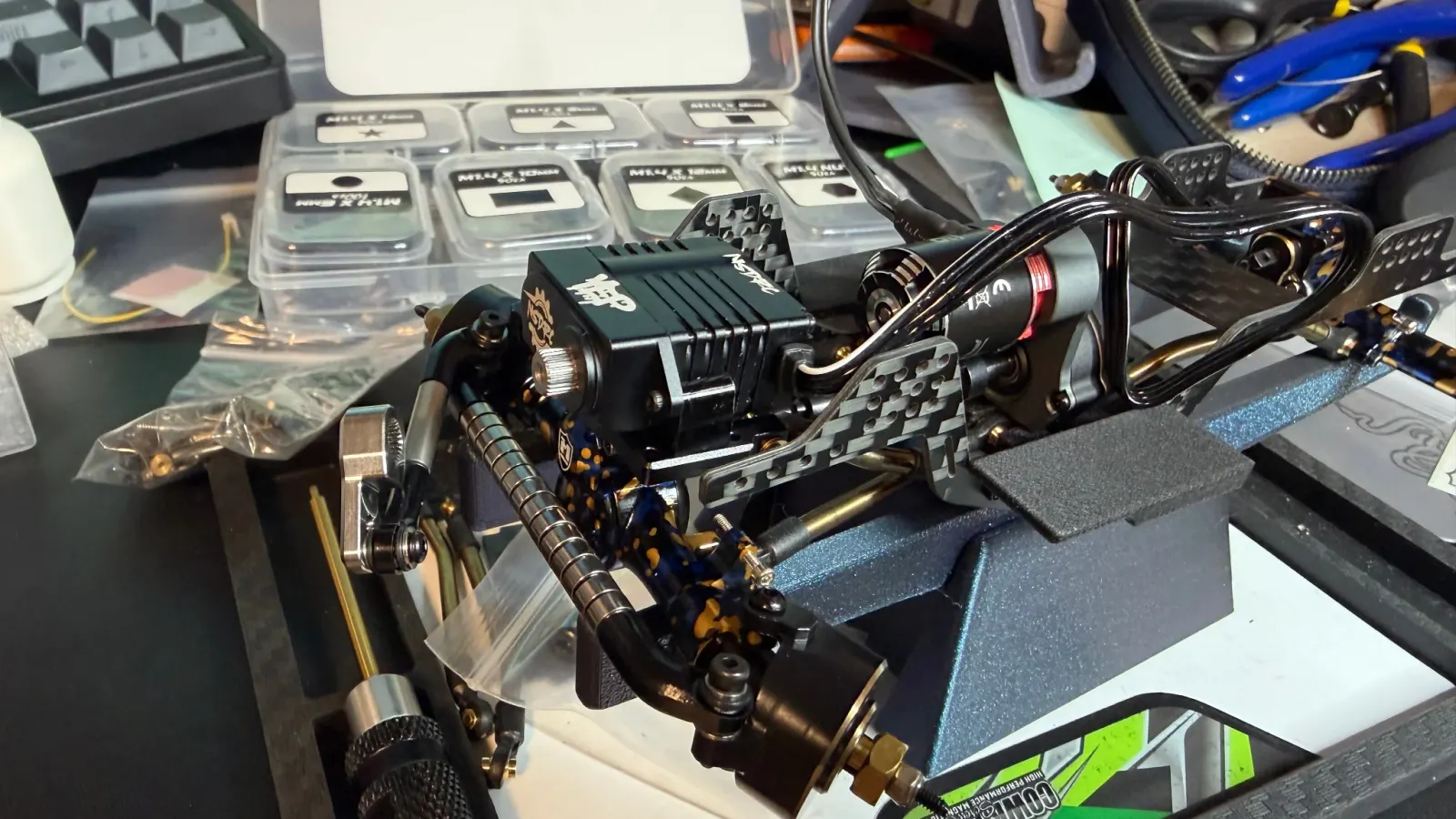
Small RC vehicles need more maintenance than big ones, not less. Every tolerance, gear, and bearing on the SCX24 is roughly a quarter the size of a 1/10 truck's, but the dust, grit, water, and impact loads it picks up on a trail are full size. Skip maintenance and the truck starts feeling sloppy fast.
I keep a small bin of supplies on the bench and run through the checklist below after every trail session. It takes about 20 minutes and adds years to the truck.
Why micro crawlers punish neglect
- Sealed gearcases aren't actually sealed. The plastic axle housings have visible gaps around the diff cover and the dogbone ports. A grain of sand that would rattle around in a 1/10 axle gets wedged in a pinion mesh on an SCX24.
- Tiny bearings, high RPM. The stock motor spins small bearings fast. Contamination kills micro bearings 10 times faster than 1/10 bearings because there's so little material between race and ball.
- Exposed pinion and spur. The motor pinion sits behind the motor with minimal shielding. Snow, mud splatter, and beach sand land directly on the gear mesh.
- Tight tolerances on brass upgrades. Once you swap brass knuckles, brass C-hubs, or upgraded steering links in, clearances get tighter. Dirt that was harmless on plastic now causes binding.
The kit you need
- Compressed air (a $10 can or a USB blower)
- Stiff-bristled brush (toothbrush or a small detail brush)
- Isopropyl alcohol 90%+
- Cotton swabs and lint-free cloth
- Plastic-safe degreaser for gear cases
- Light bearing oil (3-in-1 or a dedicated RC bearing oil)
- CowRC Udder Butter grease for the axle gears and the transmission worm
- Hex driver set (1.3, 1.5, 2.0mm)
- Blue threadlocker
- Tire cleaning solution if you run sticky compounds
After every session (the 20-minute routine)
- Blow off the loose dirt. Compressed air at low pressure over the chassis, axles, and motor. Pay attention to the pinion area and the gaps around the diff covers.
- Brush the gear mesh visible from outside. Pinion-to-spur and any exposed gear teeth.
- Wipe the chassis with a damp cloth. Dirt that's dried on comes off easier than dirt that's been baked in for a week.
- Check every screw on the axle housings, motor mount, and skid. Anything loose gets threadlocked. Anything stripped gets replaced.
- Check the tires. Loose beadlocks get re-screwed. Worn foam inserts get replaced when the sidewall starts collapsing on hard side hills.
- Pull the battery. Either charge it or storage-charge it depending on when you'll drive next. Don't leave LiPos fully charged on the shelf.
Every 5 to 10 sessions
- Open the front diff. Two screws, pull the cover, wipe the grease, check the worm and worm gear for wear or stripped teeth. Re-grease with Udder Butter. Reassemble with blue threadlock on the cover screws.
- Open the rear diff. Same drill.
- Open the transmission. Check the spur and the transfer gears. Re-grease the worm gear. Watch for plastic shavings (sign of stripping).
- Inspect bearings. Spin each one. Notchy or sticky bearings get replaced. Cheap.
- Inspect dogbones or CVDs. Plastic dogbones with rounded lobes are about to fail. Replace before they pop out on the trail.
- Check shock pre-load and oil level. Top off oil if the shocks have leaked. Re-bleed if they feel inconsistent.
Every 25 to 50 sessions or once a season
- Full tear-down and rebuild. Axles apart, transmission apart, shocks apart, everything cleaned and re-greased. Bearings replaced if any are notchy. Threadlock everywhere.
- Replace stock shocks if you're still on them. By this point the foam inserts are well past their prime.
- Replace stock CVDs or dogbones if you're still on them. Even if they look OK, fatigue is real.
Battery and electronics care
- Storage voltage for LiPos not used within a few days. 3.8V per cell. Most balance chargers have a one-button storage mode.
- Don't leave packs flat. Recharge to at least storage voltage within 24 hours of running.
- Inspect packs before charging. Puffy = dispose, don't charge. Hot to the touch = let cool first.
- Wipe down the ESC and receiver if they got wet. Isopropyl alcohol, then compressed air. Let them fully dry before powering up.
- Charge in a LiPo bag. Always. The cost of one accident pays for the bag a hundred times over.
Common failure modes to watch for
- Stripped axle worm gear. Symptom: clicking from the diff under load. Cause: stock plastic gear + brushless or heavy brass. Fix: hardened steel worm replacement.
- Cracked plastic knuckle. Symptom: knuckle moves with the wheel but loose. Cause: impact, fatigue. Fix: brass knuckles.
- Stripped dogbone. Symptom: drivetrain noise at full lock, eventual no-drive. Fix: CVD or hardened steel dogbones.
- Worn shock foam. Symptom: shocks feel inconsistent, no damping. Fix: replace foam or upgrade to oil shocks.
- Servo gear strip. Symptom: humming at one steering endpoint, slow or weak response. Cause: cheap servo or stalled endpoints. Fix: replace servo, set endpoints inside the mechanical stops.
- Loose body posts. Symptom: body wobbles or shifts on impacts. Fix: threadlock and re-tighten.
- Brushed motor losing power over time. Symptom: top speed drops, gets warm faster. Cause: brush wear. Fix: replace motor (around $10).
Storage between sessions
If the truck sits for more than a couple weeks:
- Storage-charge the batteries.
- Wipe the chassis clean.
- Loosen the body clips one notch to relax the body shell.
- Store in a dry place out of direct sunlight (UV ages tires and bodies fast).
- Don't leave it in a hot car. Heat kills LiPos and warps bodies.
Common problems and how to fix them in detail in the common SCX24 problems guide. Tools and hardware you should have on hand in the tools and hardware guide.