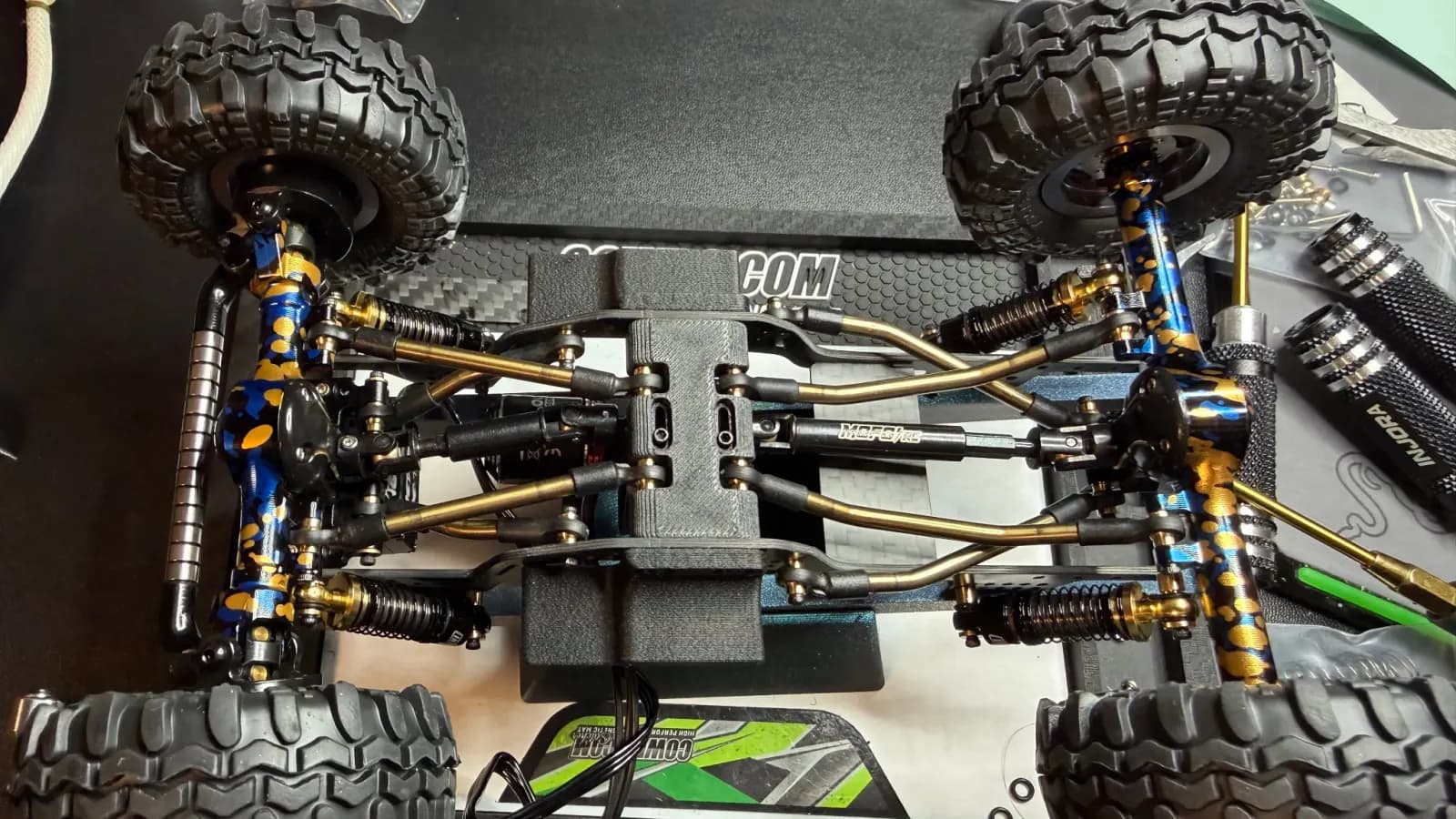
Stock SCX24 shocks are friction shocks. They're fine for an out-of-the-box truck and they're what holds back the suspension once you start adding brass and bigger tires. Upgrading to oil-filled shocks is the upgrade that quietly fixes a lot of complaints people don't even know they have. Here's how shocks actually work on a 1/24 and what changes when you replace them.
What a shock does
Two parts working together inside one body:
- The spring stores energy. It compresses under load and pushes back. Determines ride height and how much force is needed to compress the suspension.
- The damper dissipates energy. Resists the speed of compression and rebound so the spring doesn't oscillate forever. This is the part that's either “friction” or “oil-filled” on an SCX24.
On a fast 1/10 basher you also want shocks to soak landings. On a 1/24 crawler you almost never get airtime. The entire shock job is slow, controlled motion that keeps rubber loaded against terrain. Independent tire loading is the actual goal.
Friction shocks (what ships stock)
The stock SCX24 shock is a plastic body with a foam insert that grips the shaft. Friction between the foam and the shaft is the entire damping mechanism. Pros: cheap, sealed, never leak. Cons:
- Stiction. Static friction is higher than dynamic friction, so the shock won't start moving until something pushes harder than the breakaway threshold. Then it lurches.
- Inconsistent damping. The foam compresses over time and absorbs trail dirt. Same shock behaves differently month to month.
- No tunability. Spring rate is the only thing you can change. No oil weight, no piston, no preload collar.
Oil-filled shocks (the upgrade)
Aluminum body, internal piston, sealed cartridge filled with shock oil. Damping comes from the oil being forced through holes in the piston as the shaft moves. Tuning the oil weight changes the damping rate without changing anything mechanical.
What you gain:
- Consistency. Same damping every cycle, every day.
- No stiction. The shock starts moving as soon as load is applied.
- Tunability. Change oil weight, change pre-load, change piston in some models.
- Better tire contact. The suspension actually moves over small surface variations, so tires stay loaded on uneven rock.
Travel
Shock length (eye-to-eye) controls how much suspension travel you have. SCX24 shocks cluster around four lengths:
- 32mm. Stock-class. Limited articulation.
- 39 to 43mm. The sweet spot for stock-wheelbase builds. More articulation, no body interference.
- 45 to 48mm. Long-travel comp setup. Often needs LCG chassis to clear the body. Maximum articulation.
Longer shocks add articulation but also raise the body if you don't adjust the mounts. Most builders running 43mm shocks on stock geometry end up with a slightly taller truck. Often a feature, sometimes not.
Pre-load
Pre-load is how compressed the spring is at full extension (when no weight is on the wheel). Adjust by spinning a collar on the shock body. Pre-load sets ride height. It does not change spring rate.
Too little pre-load and the truck sags into its travel under static weight, leaving no compression travel. Too much and the truck rides high and the suspension can't droop. Sweet spot: with the truck on a flat surface, the shock should be sitting roughly at its midpoint of travel.
Spring rate
Force per mm of compression. Stiffer spring resists weight more. Most SCX24 oil-shock kits ship with a soft, medium, and hard set of springs that you can swap.
- Soft springs let the suspension move over small surfaces. Good for grip.
- Medium is a reasonable default for stock-weight builds.
- Hard springs keep the chassis from squatting under heavy brass and big batteries.
Choose springs to match how heavy your truck is. A stock-weight rig with hard springs feels like it has no suspension at all.
Oil weight
Damping force scales with oil viscosity. Heavier oil = more damping.
- 20 to 30wt: light damping, fast rebound, good for technical low-speed crawling.
- 40 to 50wt: mid-range. Default for most builds.
- 60wt+: heavy damping for brushless trucks that punch hard.
Tuning oil weight is what comp builders spend the most time on once they have the right shock body. Detailed tuning procedure in the shock tuning how-to.
My picks
For oil-filled shock upgrades on stock SCX24 geometry:
- INJORA 39mm or 43mm threaded oil shocks. Around $25 for a set of 4. Cheapest decent oil shocks on the platform. Aluminum body, pre-load collar, ships with multiple springs and a small bottle of oil.
- Pro-Line Big Bore Micro. $40 to $50. Bigger body, more travel, more tunable. Comp pick.
- Mofo RC oil shocks. Premium tier, comp-grade machining.
Where shocks sit in the overall upgrade plan: see the staged upgrade path. Once you've got shocks dialed, the matching upgrade is usually a chassis upgrade to make full use of the articulation.