
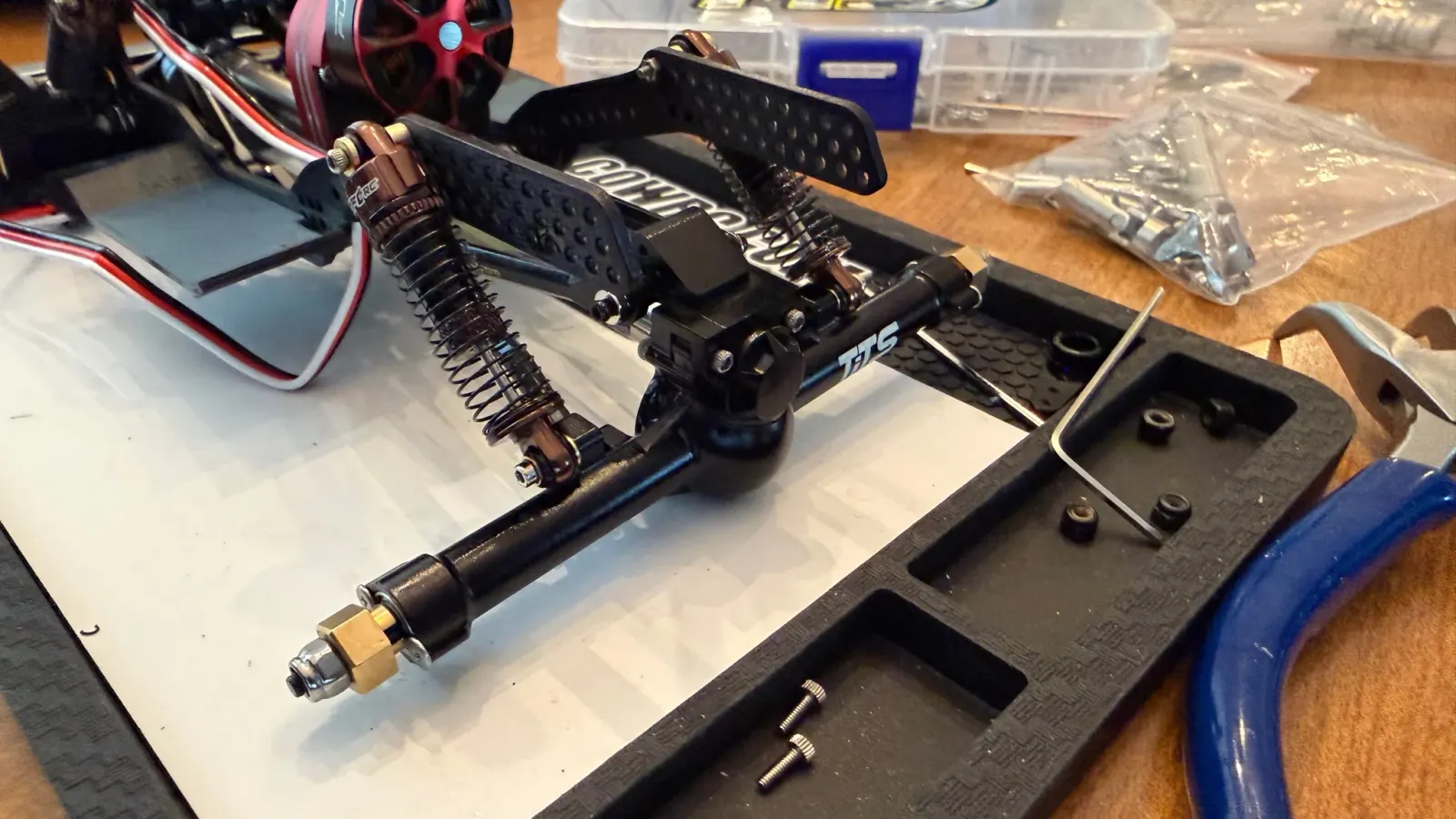
Oil-filled shocks have six things you can tune. Change them one at a time or you'll never learn what each one does. This article walks through the variables in order of importance, with practical starting points for SCX24-class builds. If you're still on stock friction shocks, this article isn't for you yet. Start with the shocks explainer and pick an oil-filled set first.
What you can tune
- Oil weight (damping)
- Spring rate (ride height resistance)
- Spring pre-load (static ride height)
- Shock length (travel and articulation)
- Oil fill level (how much air is left, affects bottom-out)
- Piston configuration on some shocks (hole count and size)
Change one variable per session, test on the same line, and write down what you changed. If you're using rcbldr.com, the Notes field on the build is exactly the right place for this.
Start with spring rate
Spring rate matches the weight of your truck. Wrong spring rate and no amount of oil tuning will save you.
- Stock-weight truck (around 350g): use soft springs.
- Brass-equipped truck (450 to 500g): medium springs.
- Heavy brass + portals build (550g+): hard springs.
Right rate test: with the truck sitting on a flat surface, the shock should be at roughly its midpoint of travel. Compression travel and droop travel should be roughly equal. If the truck sags into its travel under static weight, springs are too soft. If the truck rides high and the suspension barely moves, too hard.
Set pre-load second
Pre-load sets ride height. It does not change spring rate. Adjust by spinning the pre-load collar.
Two methods for setting pre-load symmetrically:
- Eye-to-eye: measure the distance from the upper mount to the lower mount with the shock off the truck. Match all four within 0.5mm.
- Spring length: count visible threads above the collar. Match all four.
Asymmetric pre-load makes the truck sit crooked and pulls under throttle. Worth the five minutes to get right.
Then dial oil weight
Damping. Heavier oil = more resistance to fast shaft motion.
- 20 to 30wt: light damping. Suspension rebounds fast. Good for slow, technical crawling where the wheels need to track surface contours quickly.
- 40 to 50wt: mid-range. Default for most builds. Compromise between rebound speed and chassis control.
- 60 to 80wt: heavy damping. Suspension rebounds slowly. Good for brushless trucks that punch hard and need the shocks to control weight transfer.
For a first oil shock setup on a stock-weight SCX24, start at 30wt. Drive it. Then either drop to 20wt if it feels too slow, or step up if it pogos.
Set shock length last
Most SCX24 oil shocks come in 39, 43, or 45mm eye-to-eye lengths. Longer means more articulation and a slightly taller truck.
- 39mm: closest to stock geometry. No body interference. Conservative articulation.
- 43mm: sweet spot for stock-wheelbase builds. Noticeable articulation gain. Usually fits stock bodies.
- 45 to 48mm: comp long-travel. Often needs an LCG chassis or body lift to clear.
Don't buy longer shocks expecting more travel without checking that the body and suspension can use it. The shock has to be the limiting factor for the longer length to actually help.
Oil fill level
Fill the shock body with oil until the shock is full and there's a small air pocket at the top (1 to 2mm below the cap). Compress and extend the shock a few times to purge bubbles. Close the cap with the shaft mostly extended.
Too much air in the shock acts as a soft secondary spring and the shock feels bouncy at the end of travel. Too little air and the shock can't fully compress because hydraulic lock.
Bleeding and rebuild
SCX24 oil shocks bleed by repeatedly compressing the shock fully with the cap off, then topping up oil, then compressing again until no bubbles come out. Five or six cycles usually does it.
Rebuilds: pull the shocks apart every six months or so. Replace o-rings if they look worn. Fresh oil makes a noticeable difference.
Tuning procedure summary
- Pick spring rate to match truck weight. Test ride height.
- Set pre-load symmetrically. Check ride height again.
- Pick oil weight. Start mid-range (30 to 40wt) for trail, heavier for brushless.
- Set shock length last. Match to body and chassis clearance.
- Drive the same line repeatedly. Change one variable, drive again, compare.
- Write everything down. You will forget.
Common mistakes
- Changing two things at once. Now you don't know what helped.
- Setting pre-load to fix bad spring rate. Pre-load can't fix springs that are wrong for the truck weight.
- Heavier oil for “more control.” Heavier oil slows rebound and unloads tires after they compress. Often the wrong answer.
- Mismatched left and right. Truck pulls. Annoying.
- Skipping the bench test. Compress the shock by hand. If it's notchy or sticky, the seals are wrong or the oil is contaminated.
Background on shocks themselves: see the shocks explainer. Where shocks sit in the overall upgrade plan: see the staged upgrade path.